
BMW 5 Series: Chain drive
BMW 5 Series G30 2016-2026 Training Manual / B58TU Engine / Engine Mechanical / Crankshaft drive / Chain drive
Features:
- Chain drive at the side of the engine emitting the forces
- Single-part chain drive for driving the camshafts
- Single sleeve-type chain 8 mm
- Electric motor of the combined oil-vacuum pump via a separate chain
- Plastic tensioning and guide rail
- Hydraulic chain tensioner with spring preload and sealing sleeve.
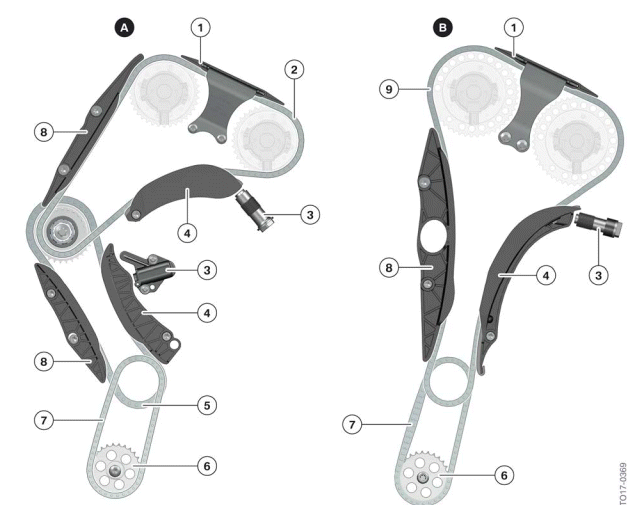
Comparison of the chain drive of B58 engine and B58TU engine
- Two-part chain drive
- Single-part chain drive
- Slide rail
- Top timing chain
- Chain tensioner
- Tensioning rail
- Bottom timing chain
- Camshaft sprocket, oil vacuum pump
- Drive chain, oil vacuum pump
- Guide rail
- Timing chain
The main difference between the chain drive compared with the B58 engine is the move from a two- part timing chain drive to a single-part timing chain drive. Deflection via the intermediate shaft on the top timing chain and the second timing chain is no longer needed. The chains used here are 8 mm sleeve-type chains. Because the intermediate gearing is no longer needed, the number of teeth on the crankshaft (23 teeth) and the VANOS adjuster (46 teeth each) has also changed.
READ NEXT:
 Chain track
Comparison between chain track of B58 engine and B58TU engine
Chain track, two-part timing chain drive B58 engine
Chain track, single-part timing chain drive B58TU engine
6-cylinder engine
Up
Valve gear
VANOS
VANOS B58 engine
VANOS B58TU engine
Following the changeover from a two-part chain drive to a single-part chain
drive, the camshaft
sprockets on the VANOS now need 46 teeth instead of the
Vacuum Supply
Vacuum pump
Oil vacuum pump, B58/B58TU engine
B58 engine, tandem oil pump with integrated vacuum pump
B58TU engine, oil pump
Vacuum pump
Oil pump
Vehicles with a gasoline engine and "traditio
SEE MORE:
Cold-start phase
Point A in the heat management module circuit diagram designates the cold
start with an engine that
has completely cooled down.
Cold-start phase, Bx8TU engine
In the cold-start phase, the coolant circulates exclusively via a bypass in
the coolant pump. The rotary
valve in the heat management mod
Rear view camera
The rear view camera supports the driver when parking and maneuvering. The
area behind the vehicle
is recorded by the rear view camera and shown on the Central Information
Display.
G30 Rear view camera image in the CID
Moving camera angle
When the moving camera angle is selected, a circular traje
© 2019-2026 Copyright www.bmw5g30.com
