
BMW 5 Series: Crankcase
Honing process
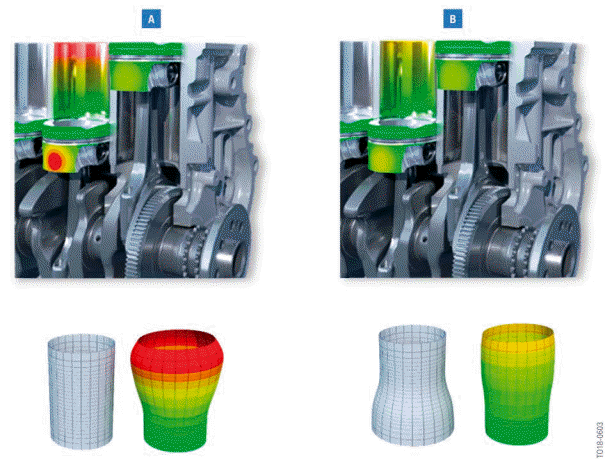
Honing process "old/new"
- Previous manufacturing process of internal cylindrical honing
- New manufacturing process of form honing
The cylindrical bore hole of a combustion engine becomes deformed during the operating condition by thermal loads. Form honing allows this deformation to be achieved in production, so that there is an almost cylindrical shape in the operating condition. This has a positive effect on the emissions quality, oil and fuel consumption, as well as output and wear.
READ NEXT:
 Chain drive
Features:
Chain drive at the side of the engine emitting the forces
Single-part chain drive for driving the camshafts
Single sleeve-type chain 8 mm
Electric motor of the combined oil-vacuum
Chain track
Comparison between chain track of B58 engine and B58TU engine
Chain track, two-part timing chain drive B58 engine
Chain track, single-part timing chain drive B58TU engine
6-cylinder engine
Up
SEE MORE:
Temperature
Concept
The automatic climate control achieves the set
temperature as quickly as possible, if needed, by
using the maximum cooling or heating capacity,
and then keeps it constant.
Adjusting
Turn the wheel to set the
desired
temperature.
Do not rapidly switch between different
temperature settings
Overview
Button in the vehicle
Park assistance button
Ultrasound sensors
With the four side ultrasound sensors, arrows,
and the ultrasound sensors of PDC Park Distance
Control in the bumpers, the parking
spaces are measured and the distances to obstacles
determined.
Functional requirements
Ultrasound sens
© 2019-2026 Copyright www.bmw5g30.com
